 |
Arno
Erban, a long time member of
the American Czech-Slovak Cultural Club, was a prisoner at both
Terezin and Auschwitz concentration camps during World War II.
Following are two articles, written by him, about his experiences,
as a young man, at those terrible places.
|
TEREZIN
by
Arno
Erban
 |
|
Terezin
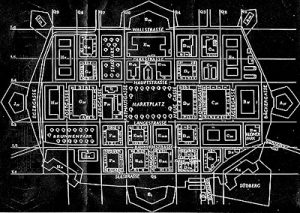
- Plan
|
Let's
talk about Terezin - where it is and what it was. Until the
beginning of World War II it was a small and quite insignificant
town located in the northern part of the Czech Republic. It
became world-renowned, however, by playing a tragic role during
the Nazi occupation of Czechoslovakia. It was built in the year
1782 by the Austrian emperor Joseph II as a fortress with all
the things which characterize a fortress, that is, a city with
a number of barracks for the sol-diers around a place for the
civil population and surrounded by high walls. It was named
Terezin or in German, Theresienstadt after the emperor's mother
Maria Theresa and the reason was to block the Prussian invasions
to that part of Europe. It was never used as a fortress because
the Prussian army just bypassed it. After that, it remained
a place for soldiers and a part of it, the so called "Little
Fortress," was converted to one of the most terrible prisons
in Europe. For ex-ample - the students, who killed the Austrian
archduke Ferdinand in Sarajevo in the year 1914, the event that
started the First World War, were imprisoned and finally killed
in Terezin. Jews were a special group of prisoners in the Little
Fortress. The Gestapo sent the Jews there for violating some
of the anti-Jewish regulations. The Little Fortress was an extermination
camp for them because the guards were there either to kill them
in their cells, at work or in roll call.
During
World War II, the Nazis expelled about 140,000 Jews, mostly
from the Czech part of Czechoslovakia, but also from central
and west-ern Europe, to the ghetto in Terezin. The idea of building
a ghetto within the walls of Terezin was made effective in November
1941. At that time Czechoslovakia was already in the hands of
Germany, and there were no Czech soldiers in Terezin anymore.
The first transports of Jews started soon after Germany's decision
to convert Terezin to a ghetto. In the first few months the
Jews were installed in the barracks. Men and boys were together
and the women, girls and little children were in different barracks
There was no possibility of any kind of communication between
the barracks. Later the Germans evacuated the civil population
to make space for new transports of Jews. After that, they sealed
the ghetto completely.
Following
the first transport of Jews from Prague on 24 November 1941,
the Council of Elders was formed. This council ran the internal
affairs of the ghetto and was directly responsible to the SS
Commander, who gave them the orders and established the rules.
The Jewish Council had the terrible task of compiling the lists
of those to be deported to the "EAST." Nobody really
knew the meaning of "EAST." The only thing we knew
was that it was something really bad. The Jewish government
was also responsible for all the activities in the ghetto, like
maintaining order, distribution of food, assignment of quarters,
sanitation and last, but not least, the care of the children.
Shortly before the end of the war all members of the Council
were sent to Auschwitz and murdered.
Of
all the big lies conceived by the Nazi propaganda, to say that
the Terezin ghetto was a paradise, that ranks as one of the
greatest. The Nazi bosses were saying textually: "While
the German soldiers are dying in the battlefields, the Jews
in Terezin are sitting in the coffeehouses eating cakes."
The math could not have been more different. From November 1941
until May 1945 this place was "the anteroom of hell."
About 150,000 people were deported to Terezin, 35,000 died there
from starvation and almost 90,000 were shipped out to the death
camps. Through Terezin passed 74,000 Czech Jews, 43,000 from
Germany, 15,000 from Austria, 5,000 from Holland and some 500
from Denmark. In the last period of the war the camp received
1,500 Slovaks and 1,000 Hungarian Jews. Of the 15,000 children
under the age of 15 who passed through Terezin less than 100
survived.
In
a place with a garrison of about 3,500 soldiers and about the
same number of civil inhabitants, the Germans established a
ghetto with 50,000 people. Prisoners lived in large barracks
and houses in the town including cellars and backyards. Men
and women lived separately in large buildings. Children under
15 years of age were separated from their parents and lived
in so called "homes." There were about 10 to 20 children
squeezed in one room, most of the time sleeping on the floor.
Prisoners
at Terezin had to observe a number of various prohibitions.
They could not have cigarettes, medications, money, matches
or lighters and they couldn't communicate with the outside world.
Punishments for violation of the regulations, imposed by the
SS commander, were very severe. For instance, early in the year
1942 the Nazis hanged 16 men, who had secretly sent letters
from the camp. The objective of these executions was the intimidation
of the other prisoners. After that, the other offenders were
sent to the Little Fortress where they were killed.
Yet
with all the hunger, cruelty and death, the inhabitants of the
Ghetto preserved their essential humanity. The artists continued
to paint, the singers to sing and poets to write while expecting
to die or to be deported. The deportation to Auschwitz was an
everyday possibility and we never knew when it would be our
turn.
The
International Red Cross was invited by the Nazis to inspect
Terezin. After a long preparation for that event, directed by
a special propaganda group, on June 23, 1944 the commission
arrived. Before their arrival, just to reduce the overcrowding,
some 7,500 prisoners were sent to Auschwitz. Buildings were
repainted, 1200 rose bushes from Holland were planted, playgrounds
for the children were constructed and even a cafe house was
adorned with tablecloths. Goebbels, the propaganda boss of Nazi
Germany, ordered a film called "The Fuhrer gives the Jews
a Town" to be made. In that film you can see happy and
healthy people, enjoying the sunshine. Good looking men and
women are shown at work in factories and workshops or vegetable
gardens, children were playing soccer and acting in the children's
opera Brundibar. Apparently the Red Cross delegation was fooled.
After the war a Swiss newspaper explained that they didn't believe
the show, that they were afraid to say so. Who knows what was
the truth???
In
September 1943 there was a transport to Auschwitz, 4,000 people
survived the first "selection" after their arrival.
They were families and they were put into a new, so called,
Family Camp, something completely new. Families lived together
in one camp, surrounded by barbed wire, of course. The camp
had its own kitchen, latrine and washing facilities. In December,
the same year, two other transports from Terezin arrived to
join the people in the family camp. It gave an impression of
another ghetto and the people inside started to be optimists,
hoping that the end of the war might save them. There were about
12.000 people, men, women and children. In March 1944 all people
who came last September were loaded into trucks, taken to the
gas chamber and killed. The rest of the people stayed in the
camp. More people came in May. On June 29, six days after the
Red Cross commission had been persuaded by the Germans in Terezin
that the Jews in the camps were treated so well, liquidation
of the last German showplace, the Family Camp in Auschwitz-Birkenau
was completed. The Germans didn't need it any more. The International
Red Cross was satisfied. Very few strong men and women were
saved. Over 500 children were gassed. Ninety-eight boys over
16 years old were transferred to the men's camp. About 30 of
them survived the war.
Now,
let's talk about the children in Terezin. The Jewish Council
was really interested in doing everything possible to get some
advantages for them. There was a special department for child
care and also a separate kitchen with a little better food.
They couldn't do much for the babies and little children who
stayed with their mothers. The children from 10 until 15 years
had their own "homes." The girls occupied a big building
in the main plaza next to the SS commando. The boys occupied
the former school building, which was divided into 6 homes.
I was called to become a teacher or leader of one of the homes
because of my former experience with children as teacher and
counselor in different vacation camps.
Our
home was Home No. 9 and was well known in the ghetto. Forty-two
boys, 13 and 14 years old in a room with 3 story beds and a
big table in the center, became a substitute for a real home
for all of them during 1942 to the end of 1944. There were several
hundreds of them, because they were coming and leaving with
the transports. They were separated from their families and
became a group of friends who lived together and loved each
other. Home No. 9 became the place of their new family. Most
of them had to work in the fields and gardens, in maintenance
or in different workshops. The education permitted by the Germans
was only for manual skills. But against the orders, education
was a major issue in our life. There were many educators in
Terezin who helped us to teach the children. Many famous writers
and poets visited our home and so did famous musicians and philosophers.
Home No. 9 was known for its good organization. It had its own
boys' self-government. They published their own magazine and
also there was a daily competition where the boys competed in
different disciplines of their life and were awarded points
for their behavior, for fixing their beds, for playing chess
or other games, for their studies, for poetry, for drawings
etc. The points were calculated daily and the results were posted
on a blackboard.
We
practiced the ideas of the Boy Scouts movement. It was a little
strange, because the ideas of this organization are connected
with nature and that was exactly what we didn't see in Terezin
but on the other hand the other things, like every day one good
deed, or one day without talking (and that was important to
learn in a prison) and so on, were quite acceptable in our situation.
One day I met two of my boys in the plaza who were carrying
a stretcher with a dead body. To my question, as to what they
were doing, they told me that they were helping two old men
who were carrying the stretcher and that this was their good
deed for the day. After that I was not too sure of my educational
methods. Normally the funeral vehicles were used to carry bread.
Just
to be able to understand the bizarre situation of some of the
children, I wish to describe a certain episode. One of my boys,
as I have called them my whole life, was sent to Terezin after
his 13th birthday. He was not of the Jewish religion and never
knew a thing about Jews. But his father and mother were Jewish
and after his father died, when he was still a baby, his mother
married a very nice non-Jewish man. The man adopted the boy,
gave him his name and later, when they had 2 more children,
they all lived as one happy family. When he was sent to the
ghetto, he was completely confused.
On
one of my birthdays the boys gave me a great present. They gave
me a book, made by them with painted emblems of 3 different
scout groups, the Beavers, the Archers and the Wolves. It was
signed by all who were in our home at this time. I was lucky
to recover the book after the war and it has become my greatest
treasure. After the first pages with the emblems it contains
the best Czech and world poetry.
The
boys suffered from many different diseases like encephalitis,
scarlet fever, typhus, impetigo and other infections. There
were very good doctors in Terezin, but very little medicine.
Due to insufficient food rations their weakened bodies became
easy prey to various diseases.
The
children in Terezin were quite creative. They wrote poems and
they produced a lot of good drawings and paintings. Some of
them survived the war and are shown around the world. The Terezin
motto to survive and to demonstrate that the Germans could beat
us but they cannot subdue us was "I live as long as I create
and I am able to absorb culture." That was our cultural
resistance. As a member of the Czech resistance movement I began
practicing some paramilitary exercises with the boys for an
armed revolution in the ghetto. Unfortunately the transports
to Auschwitz made our plans impossible.
Now
I want to recall something that was really very special for
the children and the grownups in Terezin, the children's opera,
Brundibar. The music and the songs are beautiful and the words
tell an allegorical tale. Two impoverished children, little
Joey and little Mary, try to earn money as street entertainers
to buy milk for their ailing mother. The bad organ player, Brundibar,
angered by the competition, steals the money they earned. With
the help of 3 guardian spirits, the dog, the cat and the bird,
all the children defeated the bad guy. As the last song says:
Brundibar is defeated, we finally got him, the bad people lost
and the good people won. The boy, who played Brundibar was from
our home and so were most of the other actors. The Germans didn't
object, they knew that we were all going to Auschwitz to be
murdered. The Red Cross either didn't understand or did not
want to understand that the bad Brundibar was meant to be Hitler.
Not one of the boys survived. The opera was performed 54 times
in the building where our home was and once for the Red Cross
Commission
From
hundreds of boys, who passed through our home No. 9, in Terezin,
there were only 14 alive after the war. In 1992 we met in Prague.
It was a very emotional meeting. We were very happy to see each
other and we were very sad for those who could not make it.
The boys (all were over 70 years old) gave me a diploma that
says:
OUR
ARNO
Not
everyone in this world can be as proud of having his own "list"
as Mr. Schindler, but you - you have your own "list"
- which is not as long as the other one, but it is a list that
was produced with enormous physical and sentimental sufferings,
the desperation for the losses of our families and best friends
and the suffering of our impotence to do anything to remedy
such a situation. With your patience, your optimism and your
efforts to educate us, the children who were on their way to
becoming young men, you did not let us become an uncontrollable
group of savages. Instead you led us to believe and conserve
a strong and solid moral base with the possibility and opportunity
to grow and eventually, some day, join the human race again.
With all of this you have formed your, unfortunately not too
long, "list" from the remains of the boys of No. 9.
We will never stop thanking you for everything you have done
for us.
And
here ends my story about Terezin - Arno
Erban - January 2003
AUSCHWITZ
By
Arno Erban
 |
|
The
entrance to the Auschwitz Concentration Camp, in Poland.
The sign above the gate says,
"Work makes one free."
|
Peering
thorough a crack in the side of the car, I noticed an unusual
movement outside the train. The SS who had accompanied us until
now were replaced by others. The trainmen left the train. We
were at the end of our journey. The lines of cars began to move
again and some 20 minutes later stopped. Through the crack I
saw a desert-like terrain. Concrete pylons stretched in even
rows to the horizon, with barbed wire strung between them from
top to bottom. Signs warned us that the wires were electrically
charged with high-tension current. Hundreds of searchlights
were strung on the top of the concrete pillars. With intensive
clarity I saw hundreds of barracks, inside the enormous squares,
covered with green tarpaper and arranged to form a long rectangular
network of streets as far as my eyes could see. Figures, dressed
in the striped burlap of prisoners, moved inside the camp. The
barbed wire enclosure was interrupted every 30 or 40 yards by
elevated watch towers, with SS guards who stood leaning against
a machine gun mounted on a tripod. Heavy footsteps crunched
on the sand.
The
seals on the car doors were broken. The doors slid slowly open
and we could hear somebody giving us orders. We jumped to the
ground, the parents helping their children, because the level
of the cars was about 5 feet from the ground. The guards had
us lined up along the tracks. They divided us according to sex,
leaving all children under 14 with their mothers. The guards
told us, that we would be taken off for a bath and to be disinfected.
Afterwards we would all be reunited with our families.
We
arrived in front of a young SS officer, impeccable in his uniform
a gold rosette gracing his lapel. Later I learned that he was
the head of the SS group, and that his name was Dr. Mengele.
In addition he was the chief physician and also the head of
the Auschwitz concentration camp. In the moment, that followed,
we experienced what was called in Auschwitz selection. Dr. Mengele
was in charge of forming two groups. The left-hand group included
the aged, the crippled, the feeble and the women with children
under 14. Those too sick to walk, the aged and insane were loaded
into "Red Cross" vans. They departed with the left-hand
group. The right-hand group started to enter the concentration
camp.
One
object immediately caught our eyes. It was an immense square
chimney, built of red bricks. It was like a two story building
and looked like a strange factory chimney. We saw enormous tongues
of flame coming from its square top. Somebody told us that,
what we saw, was a crematorium. Later we saw the second and
third one with the same flames. A faint wind brought the smoke
to us. Our noses, then our throats, were filled with the nauseating
odor of burning flesh and scorched hair. Later we found out
that what was burning in the crematoriums were dead bodies of
our families and friends, who came with us in the same train.
After being selected to go to the left, they walked about 300
yards from the ramp, then they advanced along a path about 100
yards from where 10 or 12 steps led them down to an underground
room, described in several languages as a "bath and disinfecting
room." There were 3 rooms. The first one was about 200
yards long and it was brightly lit. In the middle of the room
were rows of columns and along the walls were benches. Above
the benches were numbered coat hangers. They got instructions
to leave their clothes and shoes together to avoid confusion
after the bath. The next room was equipped with showers. They
were ordered - in spite of the fact that there were men, women
and children - to take their clothes off. The young girls, especially,
were uneasy, but they had to obey. An SS man entered and opened
a door to the second room. There were no benches, but every
30 yards there were columns, not to support the ceiling, but
square sheet-iron pipes, with numerous perforations. After everybody
was inside, the SS left the room, the lights were switched off
and instead of water a gas escaped through the perforations
and within few seconds filled the room. Within 5 minutes everybody
was dead. The bodies were not lying here and there, instead
they were piled in a mass to the ceiling. The reason for that
was that the gas inundated the lower levels first and then rose
slowly toward the ceiling. This forced the victims to trample
one another in a frantic effort to escape. Yet a few feet higher
the gas reached them anyway. What a struggle for life there
must have been. They could not think, they did not know that
they were trampling over their children, wives and friends.
Their action was only an instinct of self-preservation.
After
it was over a crew of men, called Sonder-komando, who performed
all the duties in the area of crematorium, entered the gas chamber
to wash and remove the bodies to the third and final place of
their existence. They loaded 20 to 25 corpses into an elevator.
The elevator stopped in the incineration room. After stripping
the victims of their clothes and shoes, the kommando extracted
or broke off all the golden teeth and fillings and stripped
the bodies of all the valuables, The corpses were then taken
over by the "incineration-kommando." They always laid
3 bodies on a metallic pushcart. The heavy doors of the ovens
opened automatically, and the pushcart moved into a furnace
heated to incandescence. Each crematorium worked with 15 ovens
and there were 4 crematoriums.
For
years many thousands of people passed through the gas chambers
and incineration ovens. The crematoriums were attended by a
group of prisoners that got great privileges, compared with
others in the camp. They had special dormitories, good food,
and cigarettes and didn't wear prison uniforms. They did their
work for about 4 months. After that new people were called for
crematorium work. Their first duty was to incinerate the corpses
of the previous group of crematorium workers, which had been
shot by the SS. The Germans didn't want any witness' to that,
even if they were absolutely sure that they would win the war.
They probably they didn't want even the German people to find
out about the bestiality of their leaders.
People
whose destiny had directed them into the left-hand column were
transformed by the gas chambers into corpses within an hour
after their arrival. Less fortunate were those whom the adversity
had singled out for the right-hand column. They were still candidates
for death, but with the difference, that for 3 or 4 months or
as long they could endure, they had to submit to all the horrors,
the concentration camp had to offer until they dropped dead
from utter exhaustion. They bled from a thousand wounds, their
bellies were contorted with hunger, their eyes were haggard
and they moaned like the demented. They dragged their bodies
across the snow or mud until they couldn't go any farther. They
were the living death, and in prisoners language called "musulmans".
Trained dogs snapped at their wretched fleshless bodies and
the only death was their liberation.
Who
then was more fortunate, those who went to the left or those,
who went to the right? After our "right-hand" column
left the ramp, we passed in-between the different camps until
we arrived at a barracks on which "Bath and Disinfecting"
was written over the entrance. We entered and were objects of
the same routine as in the gas chambers with the remarkable
difference that in the second room there was water and not gas
coming from the pipes. Outside of the barracks were the barbers
who first shaved our heads and then the rest of our bodies.
Then they rubbed our heads with a solution of calcium chloride,
a blinding disinfectant. We were told by one of the SS that
we were not human beings any more, and we had no right to live
and from that moment were to forget our names. We would be numbers
only and not even that for a long time. Almost immediately a
man made a tattooed a number on our arms.
After
that we were taken to an empty barracks, which would be our
immediate home. We learned that Auschwitz was not a concentration
camp, but an extermination camp. In the barracks there were
about 600 people. We were unable to stretch out completely,
and we slept there both lengthwise and crosswise, with one man's
feet on another's head, neck or chest. Stripped of all human
dignity, we pushed and shoved and kicked each other in an effort
to get a few more inches space on which to sleep. We didn't
have much time to sleep because they woke us at 3 in the morning.
Guards armed with rubber clubs had us line up immediately outside.
Then began the most inhumane of all my stay in the concentration
camps -"the roll call."
The
prisoners had to stand in rows of five. The SS in charge arranged
us in order. The prisoner in charge of the barracks, usually
a man imprisoned for murder, lined us by height, the taller
ones in front and the shorter behind. He was in prison uniform,
but a clean one and neatly pressed and he was very well fed.
Then another SS guard, who was in charge of the section that
day, arrived and shouting at us put the taller ones behind the
little ones. We never knew the reason. The SS guard never accepted
the word of the barracks chief that everything was in order.
They counted us again and again, sometimes for several hours
because they counted us from front to back and back to front
or in any other possible direction. If the rows were not straight,
or our hands were not raised correctly above our heads we stood
there an hour more. In winter or in summer roll call began at
3 am and lasted until 7 am when the SS officers arrived. The
barracks leader, an obsequious servant of the SS with his green
insignia, which distinguished him from other prisoners, snapped
to attention and made his report. Then the SS officers counted
us again and put the numbers in their notebooks. If there were
any dead in the barracks they had to be brought for inspection,
naked and supported by 2 living prisoners. Sometime the kommando
in charge of the dead didn't show up and the dead had to be
physically present every day.
On
several occasions roll call became a "selection,"
similar to the one on our arrival at Auschwitz. The SS officers
headed by Dr Mengele came, accompanied by SS soldiers and dogs,
surrounded us and those chosen for the gas chamber were pushed
into vans with no possibility to escape or resistance. Some
of the prisoners were used for medical experiments almost always
with fatal results.
Those
who were in charge of Auschwitz were murdering people all day,
but at night they retired to their homes outside the camp to
live a comfortable life with their families. They had no remorse
for their "work" during the day.
That
is, how I remember Auschwitz. - Arno
Erban - January 2003
A
printable Adobe Acrobat(pdf) version of the above papers is available
by clicking here
Back
to the Papers & Links Page
|